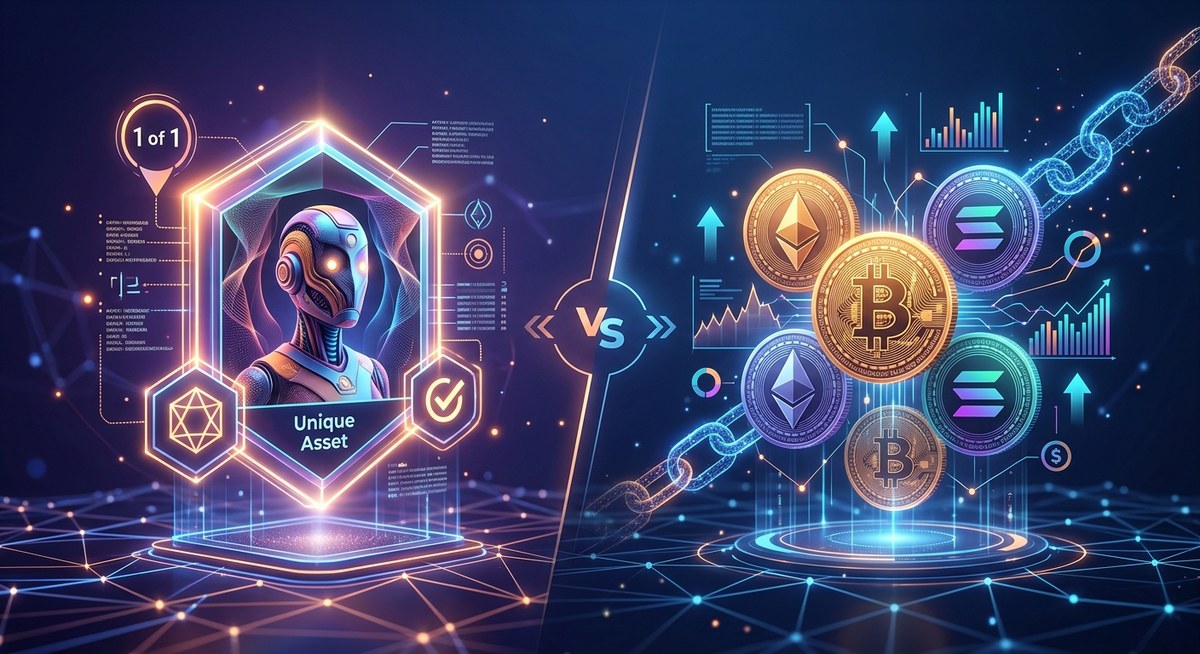
If you have been exploring the world of digital assets, you probably have run into two big terms: NFTs and cryptocurrencies. They pop up in headlines, on marketplaces, and in conversations about digital ownership and decentralized finance. At first glance they can seem similar because they both live on blockchains and leverage smart contracts. But under the hood they serve very different purposes and carry distinct risks and opportunities. BuiltWithNFT.org is here to guide you through the essentials, from how NFTs are minted to how currencies like Bitcoin and Ethereum fit into the broader crypto ecosystem. This article breaks down the differences in plain language, with practical tips to help you decide where to align your attention and funds.
What are NFTs?
Non-fungible tokens or NFTs are unique digital assets that prove ownership of a specific item or piece of content on a blockchain. Each NFT is distinct and cannot be exchanged on a one-to-one basis with another NFT. Think of NFTs as digital certificates of ownership for something that can exist online or in the real world.
Key points about NFTs:
– Non-fungible means each token has a unique identity. One NFT cannot be swapped directly for another with the same value.
– NFTs are often linked to digital art, music, video clips, virtual real estate, collectibles, and even in-game items.
– They rely on smart contracts to define ownership, provenance, royalties, and how the asset can be transferred.
– Common standards include ERC-721 and ERC-1155 on the Ethereum network, with equivalents on other blockchains.
How NFTs are created and traded:
– Minting is the process of turning a digital file into an NFT and recording its token on a blockchain.
– Ownership is recorded on a public ledger, which provides verifiable provenance.
– Secondary markets allow buyers to bid or purchase NFTs from creators or other collectors.
– Smart contracts can automate royalties, ensuring creators receive ongoing payments from future sales.
Real-world considerations for NFTs:
– Rarity and utility can drive value beyond aesthetics, such as access to exclusive communities or experiences.
– Gas fees or network fees can affect the total cost of minting or transferring an NFT.
– The liquidity of an NFT market varies by platform, project popularity, and creator reputation.
– Environmental concerns and the energy footprint of certain blockchains may influence decisions for some buyers.
What is cryptocurrency?
Cryptocurrencies are fungible digital currencies that function as a medium of exchange, store of value, or unit of account within a decentralized network. Each unit of a cryptocurrency is interchangeable with any other unit of the same type. Popular examples include Bitcoin (BTC), Ethereum (ETH), and many others.
Key points about cryptocurrencies:
– Fungible means one unit is identical in value and interchangeable with another unit of the same token.
– They rely on blockchain networks to process transactions, secure consensus, and record balances.
– Cryptocurrencies can be used for payments, as a base layer for decentralized apps, or as a store of value and speculative investment.
– They often use wallets to hold private keys, which provide access to your funds and control over transfers.
How cryptocurrencies are created and traded:
– Coins can be mined or minted through consensus mechanisms like proof of work or proof of stake, depending on the project.
– Exchanges and peer-to-peer platforms allow people to buy, sell, and trade cryptocurrencies.
– Smart contracts and programmable money enable decentralized finance (DeFi), automated lending, yield strategies, and more.
Important considerations for cryptocurrency:
– Price movements can be highly volatile and influenced by macroeconomic factors, developer activity, and market sentiment.
– Regulatory scrutiny varies by jurisdiction and can affect exchanges, on-ramps, and wallets.
– Security is critical; safeguarding private keys and using hardware wallets or reputable custodians reduces the risk of loss.
– Liquidity is usually high for major currencies but can degrade for smaller tokens.
How are NFTs and cryptocurrency similar?
Despite their differences, NFTs and cryptocurrencies share several core features:
– They are both created and traded on blockchains, leveraging distributed ledgers for transparency and security.
– Smart contracts enable automation, including ownership transfers, royalties, and access controls.
– They have built-in token standards and ecosystems, which shape how they are minted, stored, and moved.
– They are exposed to market dynamics, including speculation, narrative trends, and developer activity.
– Wallets and secure key management are essential for owning and transacting both NFTs and cryptocurrencies.
Understanding these similarities helps you see how both asset classes fit into a broader digital economy. However, the purpose and value model differ in meaningful ways, which we will explore next.
How do NFTs differ from cryptocurrency?
Here is a practical breakdown of the main differences you will notice when you dive into either space.
Fungibility vs non-fungibility
- NFTs: Each token is unique or has distinct attributes. One NFT does not equal another in a direct swap.
- Cryptocurrencies: Units are interchangeable. One ETH equals another ETH; value is based on the token type.
Use cases and value drivers
- NFTs: Ownership of a specific item, proof of provenance, access rights, and potential royalties. Value often hinges on scarcity, creator reputation, utility, and community support.
- Cryptocurrencies: Aimed at being a medium of exchange, unit of account, or store of value. Value is driven by market demand, network health, developer activity, and macro factors.
Standards and technical design
- NFTs: ERC-721 and ERC-1155 on Ethereum are common frameworks for defining unique tokens and semi-fungible assets. Other chains offer analogous standards.
- Cryptocurrencies: Native currencies are designed to be used as money within their ecosystems, with emphasis on transfer efficiency, security, and decentralization.
Market dynamics and liquidity
- NFTs: Liquidity is project and platform dependent. High profile drops or established artists can attract significant attention, but markets can be fragmented across marketplaces.
- Cryptocurrencies: Typically exhibit higher liquidity and more mature markets, with broad access on many exchanges and lower search friction for buyers and sellers.
Ownership and transfer mechanics
- NFTs: Ownership is tied to a specific token on a given chain, and transfer may involve metadata that points to a digital asset. Royalties and licensing terms can be embedded in a contract.
- Cryptocurrencies: Ownership changes through simple transfers of tokens between wallet addresses; royalties are not a standard feature.
Valuation and risk profile
- NFTs: Valuation is often subjective and tied to brand, storytelling, and community. Illiquidity risk is common.
- Cryptocurrencies: Valuation can be more game-theory driven and macro-influenced; price volatility can be steep but liquidity tends to be higher.
Token standards and smart contracts
Smart contracts are the backbone of both NFTs and cryptocurrencies, enabling trustless interactions and programmable rules. Here is a concise primer:
- ERC-721: The original standard for non-fungible tokens on Ethereum. Each token has a unique identifier and metadata that describe the asset.
- ERC-1155: A multi-token standard that supports both fungible and non-fungible tokens within a single contract. This can reduce gas costs on batch operations.
- Other blockchain equivalents: Many networks offer their own NFT and fungible token standards designed to optimize performance and costs on that chain.
Smart contracts govern:
– Ownership transfer rules and approval patterns
– Royalty logic for creators on secondary sales
– Access controls, such as gated communities or unlockable content
– Metadata management, which can be on-chain or off-chain with links to centralized storage
When evaluating an NFT or a crypto project, pay attention to:
– The contract address and its verification status
– Whether royalties are embedded in the contract and how they’re enforced
– The level of decentralization and the potential for rug pulls or exploit risk
Real world use cases and ecosystems
NFTs and cryptocurrencies have grown into diverse ecosystems. Here are representative use cases that illustrate how people actually use these technologies:
NFT use cases:
– Digital art and collectibles with verifiable ownership
– In-game items and virtual real estate with transferable rights
– Event access, memberships, and exclusive experiences
– Licensing and provenance for physical assets
– Creator royalties for ongoing revenue on secondary sales
Cryptocurrency use cases:
– Peer-to-peer payments and cross-border transfers
– Decentralized finance services such as lending, borrowing, and yield farms
– Decentralized apps and smart contract platforms
– Tokenized assets and programmable money
– Store of value and hedging against traditional financial markets in some contexts
Security, scams, and regulatory landscape
The security of both asset classes is a critical topic for new and experienced participants.
Common risks and scams:
– Rug pulls: Developers abandon a project after collecting funds or minting NFTs.
– Wash trading and market manipulation: Artificially inflating prices or volumes on certain platforms.
– Phishing and social engineering: Attackers try to steal wallets or private keys.
– Smart contract bugs: Flaws in code can lead to loss of assets.
– Fake collections and counterfeit art: Copycats and misleading metadata.
Regulatory considerations:
– KYC and AML requirements may affect how you buy, sell, and custody assets on exchanges and marketplaces.
– Tax treatment varies by country but often treats crypto as property or currency and NFTs as property or digital assets for tax purposes.
– Ongoing debates surround consumer protection, securities law, and when a token qualifies as a security versus a utility token.
Best practices for staying safe:
– Use reputable wallets and hardware wallets for long-term storage
– Verify contract addresses, verify creators, and check royalties
– Keep software up to date and enable two-factor authentication
– Start with small experiments and gradually increase exposure as you learn
How to evaluate NFT and crypto investments
If you are considering adding NFTs or cryptocurrencies to your portfolio, use a structured approach. Here is a practical checklist:
1) Define your goal
– Are you seeking short term gains, long term ownership, or strategic exposure to a project?
– Do you want access to a community or a collectible mindset?
2) Understand the fundamentals
– For NFTs: creator reputation, rarity, utility, and ongoing royalties
– For cryptocurrencies: network security, developer activity, on-chain metrics, and ecosystem growth
3) Assess the asset’s liquidity and market depth
– NFT markets can be fragmented; check multiple platforms and recent sale activity
– Crypto markets vary by liquidity; larger cap assets tend to be more tradable
4) Examine the technical and legal aspects
– Verify the contract address and metadata integrity
– Review terms for royalties and licensing
– Ensure holdings are stored in a secure wallet and consider custody options
5) Consider risk management
– Limit exposure to any single project or token
– Diversify across asset types, networks, and risk profiles
– Plan for taxes and reporting in your jurisdiction
6) Study the narrative and community
– A vibrant, long-standing community often accompanies sustainable projects
– Look for consistent improvement, transparency, and verifiable milestones
7) Start with a phased approach
– Begin with educational investments and small purchases
– Use test networks or demo environments to practice trading and minting
Getting started for beginners
If you are new to this space, a cautious, education driven approach pays off. Here are practical steps to begin:
- Choose a reputable wallet and set up a secure, encrypted backup of your seed phrase.
- Start with one or two well-known assets in a controlled amount that you are comfortable risking.
- Practice in a test environment where possible, such as test networks or sandbox marketplaces.
- Join community spaces, read project updates, and follow the development team’s progress.
- Keep a learning journal to track what works, what does not, and why.
The future landscape
The NFT and cryptocurrency ecosystems continue to evolve quickly. Some trends to watch include:
– Layer 2 scaling and cross chain interoperability that reduce costs and increase throughput
– More robust governance models and on chain identity to formalize ownership and rights
– Enhanced wallets and custodial solutions to improve security and accessibility
– Emergent use cases beyond art and collectibles, including real world asset tokenization and digital identity
Understanding these shifts will help you stay ahead and make informed decisions about where to allocate time and capital.
Practical considerations for BuiltWithNFT.org readers
As a gateway to the NFT revolution, BuiltWithNFT.org emphasizes foundational knowledge, practical steps, and critical thinking about digital ownership. This article aligns with our focus on:
– Explaining blockchain foundations behind NFTs
– Distinguishing between unique tokens and cryptocurrencies
– Exploring smart contracts and token standards
– Guiding readers toward responsible, informed participation in digital asset ecosystems
If you want to deepen your understanding, consider exploring:
– Tutorials on minting, buying, and selling NFTs safely
– Guides on selecting reliable marketplaces and verifying contract addresses
– Overviews of major token standards and how they shape asset interoperability
Common questions
How are NFTs different from digital collectibles I already own?
NFTs represent verifiable ownership on the blockchain of a digital item or its rights. Even if you can download a copy, the NFT token records who owns the original, and the contract may specify usage rights or royalties.
Do I need cryptocurrency to buy NFTs?
In most cases, yes. You typically need the network’s native currency to pay for minting, gas fees, and transaction costs. Some platforms may accept fiat conversions, but you will still interact with a cryptocurrency layer to finalize ownership on the blockchain.
Can NFTs or cryptocurrencies become obsolete?
Technology evolves quickly. While the underlying blockchain can be resilient, platforms, marketplaces, or standards can fall out of favor. Diversifying and staying informed about governance decisions helps mitigate risk.
Are NFTs and crypto taxable?
Tax treatment varies by country. In many jurisdictions, cryptocurrencies are treated as property or a similar asset, while NFTs may be subject to capital gains tax or other rules. Consult a tax professional for guidance.
Where should I start if I am curious but uncertain?
Begin with education. Read reputable guides, watch tutorials, join community discussions, and experiment with small, low risk purchases to gain firsthand experience.
Final thoughts
NFTs and cryptocurrencies sit at the intersection of technology, economics, and culture. They share a common tech foundation but serve distinct roles in the digital world. NFTs offer a way to prove ownership and unlock value from unique digital assets, while cryptocurrencies provide a flexible, fungible form of digital money and a platform for decentralized applications. By understanding their differences, you can make smarter decisions about what to explore, invest in, or build with. The journey into digital ownership is personal and evolving, so pace yourself, stay curious, and always prioritize security and learning.
If you enjoyed this guide and want more practical insights, revisit BuiltWithNFT.org for ongoing education and step by step tutorials that demystify NFTs, the blockchain, and the new economy of digital ownership.
No Responses